
O-1 Visa Filings for Extraordinary Talent
Help founders, engineers, researchers, and high-achievement professionals turn their record of work into a stronger, attorney-reviewed case.
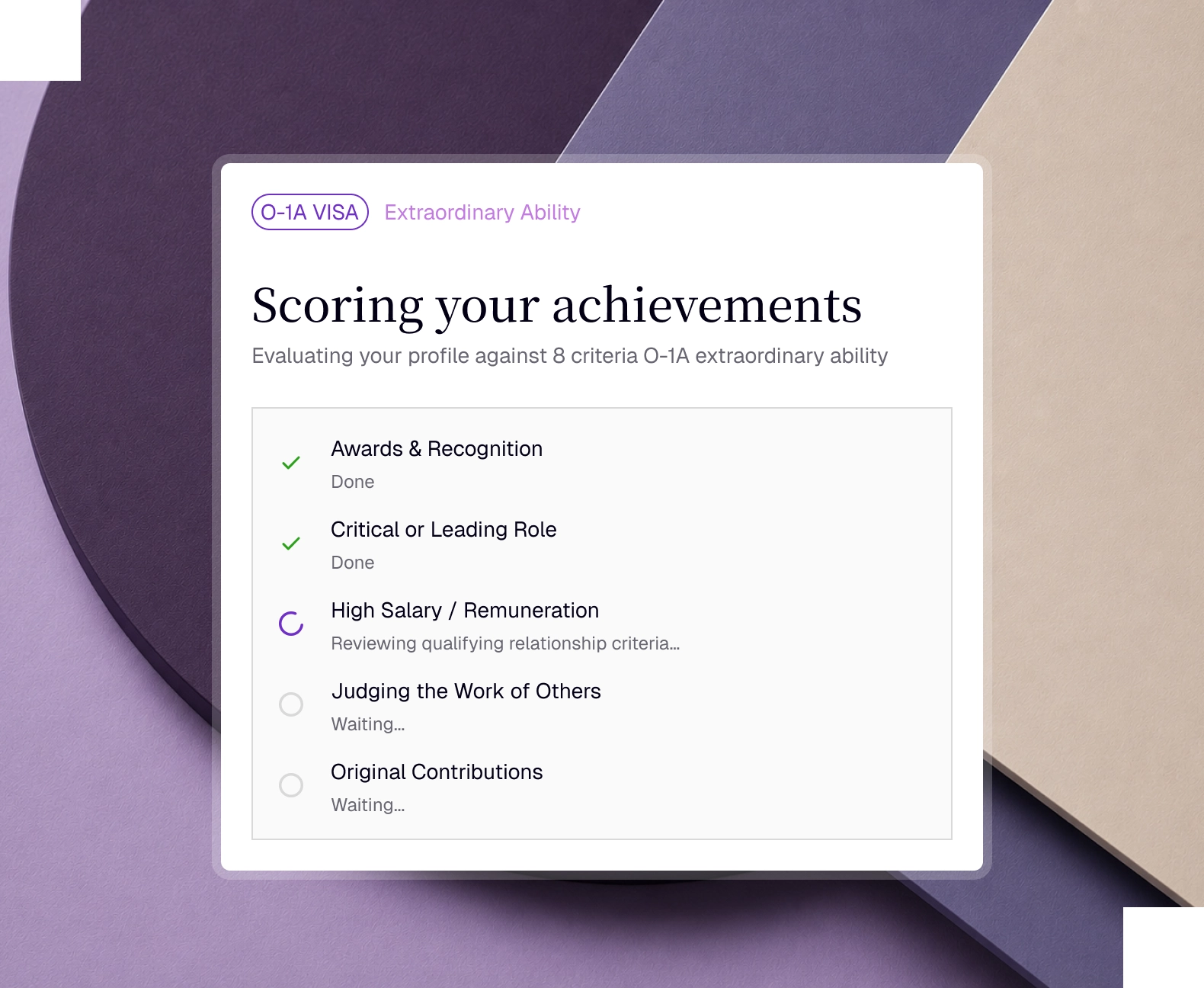
What the O-1 Visa Helps Teams Do
The O-1 visa supports individuals with extraordinary ability or achievement in their field. For high-skill talent, it can be a pathway to work in the U.S. based on a strong record of achievement.
Support extraordinary ability talent
Build around evidence of achievement
Help founders and technical leaders
Create a stronger case narrative

O-1 Delays Can
Slow Critical Talent
O-1 cases often depend on evidence quality, narrative clarity, and how achievements are organized. LegalOS helps candidates and teams structure the case before it becomes a bottleneck.
Traditional process
Scattered and Slow
- Unclear evidence requirements
- Scattered achievements
- Slow recommendation letter collection
- Weak case narrative before attorney review
The LegalOS process
Structured and Clear
- Guided O-1 profile review
- Evidence mapped to O-1 criteria
- Recommendation materials organized earlier
- Attorney-reviewed petition package
A More Structured Way to Prepare O-1 Cases
Capture the candidate’s background, work history, achievements, U.S. plans, and petitioner setup.
Organize awards, press, publications, compensation, critical roles, major contributions, and recommendation materials.
Build a clearer O-1 story around the strongest available criteria.
Experienced immigration attorneys review the materials for strength, completeness, and filing readiness.
From Intake to Filing-Ready
01
Profile Intake
Capture the candidate’s background, work history, achievements, and U.S. plans.
02
Evidence Collection
Gather supporting documents, recognition, press, awards, publications, or recommendation materials.
03
Case Narrative
Organize the strongest evidence around a clearer O-1 story.
04
Attorney Review
Review the case materials for strength, completeness, and legal confidence.




Capture the candidate’s background, work history, achievements, and U.S. plans.
Gather supporting documents, recognition, press, awards, publications, or recommendation materials.
Organize the strongest evidence around a clearer O-1 story.
Review the case materials for strength, completeness, and legal confidence.
Built for Teams Supporting Extraordinary Talent
Product and Technical Teams
Transfer employees with deep product, platform, architecture, implementation, or internal systems knowledge.

Global Operations Teams
Move employees who understand company-specific processes, customers, or workflows.

People and Business Leaders
Support specialized talent movement without letting documentation slow the business down.
.webp)
O-1 Support for
Different Talent Needs
01
Founder O-1 Cases
Support startup founders with evidence tied to company building, funding, press, traction, or leadership.
02
Technical Talent Cases
Prepare cases for engineers, AI talent, product leaders, and other high-impact technical professionals.
03
Researcher Cases
Organize publications, citations, peer review, awards, and recommendation evidence.
04
Renewals and Extensions
Support ongoing O-1 needs when talent must remain active in the U.S.
Where Speed Meets Legal Confidence
48 hours
Applications can be prepared in as little as 48 hours.
12,000+
Successful
petitions studied.
40+ years
Immigration
expertise.
10k+
Total visas filed
by attorneys.
near 100%
Reported success rate across attorney-filed visas.
Find the Right Path for Critical Talent
LegalOS supports work visas and employment-based green cards for founders, engineers, executives, researchers, and other high-skill professionals.
Transparent Pricing
Our goal is simple: complete transparency. You'll know exactly what's included from day one, with the flexibility to choose the level of support that fits your needs.
Purple
Complete O-1 preparation and filing with experienced immigration attorneys, clear communication, and visibility every step of the way.
$7,500
What's included:
- Full O-1 filing
- Live case tracking
- Attorney review backed by 40+ years of immigration experience
- Standard preparation
- Personalized case timeline
- RFE and NOID responses included
Gold
For faster, more hands-on support, Gold adds priority preparation, weekly attorney check-ins through filing, and a 60% money-back guarantee.*
$11,000
What's included:
- Full O-1 filing
- Live case tracking
- Attorney review backed by 40+ years of immigration experience
- Priority preparation in 48–72 hours
- Weekly attorney check-in calls through filing
- Personalized case timeline
- RFE and NOID responses included
- 60% money-back guarantee* Eligibility and conditions apply. See our terms for full details.
O-1 Visa
FAQs
What is the O-1 visa?
The O-1 is a temporary U.S. work visa for individuals with extraordinary ability or achievement. O-1A covers the sciences, education, business, and athletics, while O-1B covers the arts, motion pictures, and television.
Who is a good fit for the O-1 visa?
The O-1 may be a good fit for people with sustained recognition and significant achievements in their field. Qualifying evidence can include awards, media coverage, original contributions, publications, judging the work of others, leading roles, or high compensation, depending on the case.
Can startup founders qualify for an O-1?
Yes. Startup founders can qualify for O-1A status if their individual achievements meet the extraordinary ability requirements. Founding or raising money for a startup alone does not automatically qualify someone. USCIS evaluates the full record of the individual’s accomplishments.
Can software engineers qualify for an O-1?
Yes. Software engineers and other STEM professionals can qualify for O-1A status if they can demonstrate extraordinary ability through qualifying evidence and sustained recognition in their field. USCIS specifically provides guidance for evaluating O-1A evidence in STEM cases.
Is there an annual cap or lottery for the O-1?
No. The O-1 is not subject to the annual numerical cap or registration lottery that applies to many H-1B cases. An O-1 petition can be filed throughout the year when the applicant and proposed employment qualify.
Does the O-1 require employer sponsorship?
An O-1 beneficiary cannot self-petition. The petition must be filed by a U.S. employer, a U.S. agent, or a foreign employer through a U.S. agent.
Can a founder use their own company for an O-1 petitioner setup?
Yes, potentially. A founder-owned corporation or other separate legal entity can petition for its founder. The company must still establish a legitimate petitioner relationship and real, non-speculative employment in the founder’s area of extraordinary ability. Ownership by itself does not prevent the company from filing.
What evidence is usually needed for an O-1?
An O-1 petition generally includes evidence of the proposed work, the agreement between the petitioner and beneficiary, required consultation evidence where applicable, and documentation of extraordinary ability. For O-1A, an applicant may qualify through a major internationally recognized award or evidence satisfying at least three of the regulatory criteria, followed by USCIS review of the record as a whole.
How long does the O-1 process take?
Timing depends on how long it takes to prepare the petition and how USCIS processes the case. Regular USCIS processing times vary. Premium processing is available for O-1 petitions and requires USCIS to take adjudicative action within 15 business days, although an RFE or other request can extend the overall timeline.
How much does an O-1 visa cost?
Costs include legal or preparation fees and USCIS filing fees. As of 2026, the Form I-129 O filing fee is $1,055 for a regular petitioner or $530 for a qualifying small employer or nonprofit, with an additional Asylum Program Fee of $600, $300, or $0 depending on the petitioner. Optional premium processing is $2,965. Other government or consular fees may apply depending on the case.
What happens if I get an RFE?
A Request for Evidence means USCIS needs additional information before deciding the petition. The petitioner is given a deadline to submit the requested evidence, after which USCIS continues adjudicating the case. LegalOS currently states that its O-1 service includes RFE support.
Can I change employers on an O-1?
Yes, but the new employer generally must file a new O-1 petition and receive USCIS approval before the O-1 worker begins employment with that employer. Different rules may apply when a properly structured U.S. agent petition covers multiple engagements.
Can an O-1 lead to a green card?
Yes. O-1 status does not automatically become permanent residence, but an O-1 holder may separately qualify for an employment-based green card such as EB-1A, EB-2 NIW, or another category. USCIS states that pursuing permanent residence is not, by itself, a basis for denying O-1 status.
How does LegalOS help with O-1 cases?
LegalOS helps organize case information and evidence, prepare petition materials, coordinate document collection, and support filing with attorney review. LegalOS also states that filing-ready visa applications can be prepared in as little as 48 hours when the required information is available.
Who reviews my petition?
LegalOS combines its preparation workflow with review by a practicing immigration attorney before filing. I would not say that Joseph Asir personally reviews every O-1 petition unless LegalOS specifically confirms that.
What is included in LegalOS pricing?
LegalOS’s O-1 service currently includes petition preparation and filing support, document coordination, attorney review, ongoing case support, and RFE support. USCIS and other government filing fees are separate from LegalOS service pricing.
How fast can I get an O-1 visa?
LegalOS states that a petition can be prepared in as little as 48 hours once the necessary information is available. With premium processing, USCIS must take adjudicative action on the petition within 15 business days. If consular processing is required, visa appointment and issuance timing are separate and can add additional time.
How long is the O-1 valid?
An initial O-1 petition may be approved for the time needed to complete the event or activity, up to three years. Extensions may generally be granted in increments of up to one year to continue or complete the same activity, and there is no fixed overall maximum period of O-1 status as long as eligibility continues.
Should I choose the O-1 or the H-1B?
It depends on your qualifications, employer, timing, and proposed role. The O-1 has no annual lottery but requires a strong record of extraordinary ability. The H-1B has different eligibility requirements and many H-1B petitions are subject to an annual cap, although some employers and petitions are cap-exempt.
Heading 1
Heading 2
Heading 3
Heading 4
Heading 5
Heading 6
Lorem ipsum dolor sit amet, consectetur adipiscing elit, sed do eiusmod tempor incididunt ut labore et dolore magna aliqua. Ut enim ad minim veniam, quis nostrud exercitation ullamco laboris nisi ut aliquip ex ea commodo consequat. Duis aute irure dolor in reprehenderit in voluptate velit esse cillum dolore eu fugiat nulla pariatur.
Block quote
Ordered list
- Item 1
- Item 2
- Item 3
Unordered list
- Item A
- Item B
- Item C
Bold text
Emphasis
Superscript
Subscript

